Couple
Coupons
Win Jewelry
Free Earrings
Testimonials

The ring is so beautiful! I really love it! It even shipped sooner than I thought it would!

- Kristy

This ring surpassed anything that I could have imagined. I am so happy with the ring and so is my new fiance. It didn't take very long to get here. I also love the box it came in. Thank you very much.

- Michael

I was very happy with the customer service provided by Danforth! Helpful and friendly people, the product ships fast and is even more beautiful in person. I highly recommend.

- Stephen

The 4 C's - Diamond Cut

Diamond Cut – The 4 C’sDiamond Cut - Why it's Important

The cut of a diamond is especially important because it has the most effect on the fire, or brilliance. A poor cut will make the diamond look dull even with excellent color and clarity. We only carry the higher diamond cut qualities so that you don't have to worry about picking a poorly cut diamond.

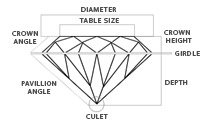
Nature dictates the characteristics of color, clarity and carat, while humans directly influence the diamond cut. Cut refers to the angles and proportions (not diamond shape) a skilled craftsman creates in transforming a rough diamond into a polished diamond. A well cut diamond will internally reflect light from one mirror-like facet to another, dispersing and reflecting it through the top of the stone. This results in a display of fire or brilliance in the diamond. The cutter must polish tiny surfaces known as facets onto the rough diamond. This diamond cutting process also creates the diamond parts known as the crown, culet, table, girdle and pavilion.

More About Diamonds:

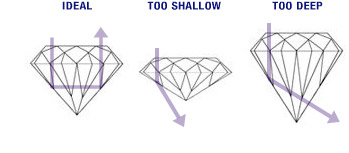
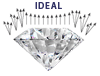
Ideal Cut Diamond - Nearly all light that enters the stone is reflected out of the top, designed to maximize brilliance.

Shallow Cut Diamond - Light will be lost out of the bottom or sides causing the diamond to lose its fire or brilliance.

Deep Cut Diamond - Light will travel out of the bottom or sides making the stone look dark and dull

Symmetry and Polish

A diamond's brilliance depends on two key characteristics of its cut: symmetry and polish. Symmetry refers to the angles at which the "facets" (the stone's smooth, angled surfaces) align. Proper symmetry reflects light from one surface to another repeatedly throughout the diamond (allowing as little light as possible to escape). The facets, when arranged in precise proportions, will maximize the fire and brilliance of a diamond. To cut a diamond perfectly, a craftsman will often need to cut away more than 50% of the rough diamond, therefore cutters are often tempted to sacrifice brilliance for a larger stone. Polish refers to how smooth those surfaces actually are. Smoother surfaces create a more acute reflection of light (i.e. without blurring) to maximize the amount and quality of reflection.

Diamond Cut – The 4 C’sGood Proportions are Key

Diameter: The width of the diamond as measured through the girdle.

Table: The top surface (largest facet) of a diamond that extends from the girdle.

Crown: The upper facets of the diamond, above the girdle, leading to the table or top of the diamond.

Girdle: The band around the widest part of a diamond.

Pavilion: The bottom portion of a diamond extending from the girdle to the culet, sometimes referred to as the base. Also called the bottom half.

Culet: The facet at the tip (bottom) of a gemstone. The preferred culet is not visible with the unaided eye (graded "medium" or "none").

Depth: The height of a gemstone measured from the culet to the table.

Which Diamond Cut Should I Buy?

At Danforth Diamond, we grade diamonds based on scales created by the American Gem Society and the Gemological Institute of America. To make the best choice you need to understand the various diamond grades. These grades include:

Ideal cut:
Our Ideal cut is the best cut available. Ideally you want a table and percentage that provides the best balance of brilliance (reflected light) and dispersion/fire (reflected hues), and a depth percentage that allows for the highest yield of return light. This category represents approximately the top 15% of all diamond cuts and carries the highest possible grades of symmetry and polish. Learn more about Ideal cut diamonds.

Depth - 59-62.7%
Table - 53-58%
Girdle - Thin to slightly thick
Culet - None to medium
Symmetry & Polish - Excellent to Very Good

They reflect nearly all of the light that enters the stone and are designed to maximize brilliance.

Very Good cut:
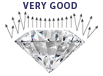
Diamonds graded as Very Good reflect much of the light that enters the stone. These diamonds usually trade in some of their brilliance for added size. They are a cost-effective option, but may begin to stray outside of the preferred range of some buyers in terms of appearance. These diamonds represent the top 25% of diamond cuts.

Depth- 58.6-63%
Table- 53-62%
Girdle- Very thin to thick
Culet - None to medium
Symmetry & Polish- Excellent to Good

Light is reflected from one facet to another before shining through the top of the diamond.

Good cut:
This category represents the top 35% of diamond cuts. While they may still be quality diamonds, they will show a significant lack of brilliance. They are, however, considerably less expensive than the grades above them.

Depth- 56.6-64.7%
Table- 53-64%
Girdle- Very thin to Very thick
Culet - None to medium
Symmetry & Polish- Excellent to Good

Light escapes through the opposite side of the pavilion, losing sparkle and brilliance.

Fair & Poor cut:
These are diamonds that simply fail to reflect a sufficient amount of light. In most cases, they are too shallow or too deep to meet the minimum standards of a Good cut. Depth <56.5 or >64.8 / Table <53 or >64. These diamonds are usually found at Jewelry discounters and in promotional jewelry. To ensure that we're offering you diamonds of only the highest quality, Danforth does not carry diamonds rated fair or poor.

About Diamonds - 4 C's

Expert Guidance

Of the 4 C's, the cut of a diamond is the most important factor in its overall appearance. In addition, because it's the only one of the 4 C's that relies on the precision of human hands, it also is the one to which the value of your diamond will be most closely tied.

Once you've identified your budget, start by choosing the proper cut - and don't look back. By choosing the most brilliant cut possible, you will have the most flexibility in tailoring the grades of the other 4 C's to fit your budget without compromising the beauty of the stone.

Also, note that cut and shape are not the same thing. Shape refers to the outward appearance of the diamond; round, emerald, heart, marquise, princess, oval or pear. A round diamond is the most brilliant of diamond shapes. Its symmetrical outline allows it to reflect nearly all of the light that enters the diamond.

Use the links below to learn more about diamonds and the 4 C's:

Now that you’ve learned all about diamonds; use your knowledge to shop for your perfect diamond engagement ring.


experts@DanforthDiamond.com

Need Guidance on Picking Perfect Diamond Engagement Rings?

Find the diamond engagement ring support you need by visiting our Learning Center. Find information on choosing diamonds, understanding precious metals, and picking the perfect engagement ring.

Craftsmanship is important. That's why Danforth Diamond offers a 30-day return policy, a lifetime warranty and testimonials from real customers. We are confident in the quality of our diamond engagement rings and eco-friendly jewelry. As a reputable online engagement rings store, our engagement rings are sold at wholesale to ensure you get the right ring at the right price.

Start creating your custom diamond engagement ring today.

To speak directly to an engagement ring expert contact Danforth Diamond, Monday-Friday, 9AM-6PM EST. Please call 1.877.404.RING toll-free. Outside the U.S. and Canada, call 001.804.794.1118. Or, email us at experts@DanforthDiamond.com.