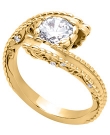
14K Yellow Gold 10.50 mm Bypass Diamond Engagement Ring (.08 ct. tw.)
Add a Diamond!


Need some help understanding jewelry terminology? Search our diamond engagement ring and jewelry terms for words commonly used in the jewelry industry. Be an informed shopper when browsing our selection of diamond rings and jewelry.
Looking for specific jewelry terminology? Find it quickly by clicking on the appropriate alphabet letter below:
A B C D E F G H I J K L M N O P Q R S T U V W X Y Z
12 term(s)
Minuscule nicks along facet junctions, producing white hazy lines instead of sharp facet edges.
The American Gem Society, founded and supported by approximately 1,000 high-end jewelers. They are recognized as one of the top gemstone grading organizations.
The American Gem Society Laboratories, an industry leader in diamond grading.
The American Gem Trade Association, an industry leader in diamond grading.
Refers to the coloring by minor impurities of stones, which, if pure would be colorless.
Refers to the "mixing" of different metals with Gold to increase hardness and/or change the color. Two or more metals are melted together, resulting in a compound metal, or alloy.
A heating enhancement process used with color gemstones. The term originated with the Independent Gemological Laboratories (IGL), an industry leader in diamond grading specializing in larger stones. Also, a heating process to soften precious metals.
A formal evaluation process through which the value of a diamond (or any item) is determined and documented. It takes into account every aspect of a diamond's characteristics and dimensions, and serves as the basis for determining the proper insurance coverage rate for the item.
A test of the purity of an alloy. A tiny piece of metal is scraped from the piece and the percentage of gold or silver is determined.
A unique, square-shaped cut diamond with rectangular facets.
A basis for weighing things other than jewels and precious metals. The unit is a pound containing 7000 Troy grains. The Troy pound contains 5760 grams.
In blanks for wedding rings, or other jewelry made to be set with stones, the settings are said to be "azured" when each has the hollow for the pavilion of its stone formed into a square; the space below the girdle of the stone has the form of a truncated pyramid. The azure allows more light into the stone, enhancing its reflective qualities.
29 term(s)
Standard American gauge used for measuring thickness of wire and sheet. The lower the number gauge, the thicker the material (e.g. 30 gauge = .010", 18 gauge = .040")
A rectangular shaped diamond with rows of step-like facets. If the baguette's two long sides taper inward, it is called a tapered baguette.
A finding, connected to pendants or stones worn as pendants to accommodate a chain, cord or thong.
A ring that is made from a thin, flat, ribbon-like strip of material (usually metal).
Similar to the channel setting, it is a circular band of diamonds that holds each stone in by a long thin bar, shared between two stones.
Similar to the channel setting, it is a circular band of diamonds that holds each stone in by a long thin bar, shared between two stones.
A diamond cut with a traditional step cut crown and a modified brilliant cut pavilion. A square barion cut diamond has 61 facets, excluding the culet.
Metals which are commonly used to alloy gold jewelry, e.g. copper, silver, zinc, nickel, platinum and palladium.
Precious metal is a rare metallic chemical element of high economic value that is used for art, jewelry and coinage. Chemically, precious metals are less reactive than most other elements, have high luster, are softer and have higher melting points than other metals. The most popular metals for jewelry are:
Yellow gold: The most popular gold alloy. An alloy of gold, silver, copper and sometimes zinc.
White gold: An alloy of gold, with nickel or palladium.
Palladium: Stronger than white gold, palladium is a pure white metal from the platinum family.
Platinum: A white metal, and one of the hardest and more popular metals used in engagement rings today.
Silver: The whitest of jewelry metals, harder than gold, softer than copper, more malleable and ductile than any metal except gold.
A method of diamond setting in which the stones are set flush in a strip of metal. The stones are held by the beads, which are raised by the diamond setter from the surrounding metal.
The outermost portion of the diamond, called the girdle, can develop small cracks that resemble whiskers during the polishing process. These whiskers, or bearding, can sometimes be removed, if not too dramatic, with slight re-polishing, and if the weight allows.
A stone cut with a large table and the edges beveled by a single facet; the bottom may be cut normally, or it may be the same as the top, in which case it is known as double bevel cut.
Also called kite facets, because of their shape, bezel facets are cut along the crown or top of the diamond or gemstone.
A setting in which a metal rim holds the stone and completely surrounds the gem. Bezels can have straight edges, scalloped edges or can be molded into any shape to accommodate the stone.
A term used for truly black diamonds and for carbonado.
A lumpy diamond with an overly deep pavilion.
Any type of flaw on the surface of a diamond or other gemstone.
An alloy of light blue color usually composed of iron and gold. Not commonly used in making jewelry because the iron causes a very brittle alloy.
Found in marquise, oval, pear and some heart shaped diamonds. The bow tie looks like two dark triangle shapes joined at the point in the center of the diamond. This is caused by light leaking from the stone and is considered to be a liability if it is prominent. It can be caused from an overly deep pavilion.
A setting for a stone in a ring, the top edges of the "box" being burnished over the edges of a stone to hold the stone in the setting.
Precious metal alloys designed to melt before the alloy that a jeweler will join together. The solder is heated to a liquid state and two pieces of metal are joined together.
The amount of light reflected through and out of a diamond. A stone's brilliance depends on two key characteristics of its cut: symmetry and polish.
The term for a cut with 58 facets. These cuts are scientifically found to reflect the most light from within the stone and often are considered to have the most brilliance of all cuts.
A type of minor flaw on the surface of a diamond or other gemstone characterized by a root-like appearance (like a cracked windshield) inside the stone.
A girdle cut that leaves the girdle with a frostlike appearance.
An apparent void; often they are included crystals of some foreign substance, but so colorless and so different in refractive index that they resemble cavities.
24K of fine gold or fine silver in bar, ingot or other form, as distinguished from coin.
A gas or electrically powered furnace used to eliminate, by burning out, the wax from investment molds. Used in the casting process to manufacture jewelry.
29 term(s)
A fancy diamond with a strong, pleasing yellow color.
One of the "4 C's," carat is the term used to define the measure of weight of a diamond. One carat is the equivalent of 200 milligrams. One carat can also be divided into 100 "points." A .75-carat diamond is the same as a 75-point or ¾-carat diamond.
You can learn more about carat in our Learning Center.

Palladium: Stronger than white gold, palladium is a pure white metal from the platinum family.
An unfaceted form of cutting where the stone is given a rounded, convex shape and cut high or low for best effect.
A tiny flaw, in the form of a hole, on the surface of a diamond or other gemstone. In higher-quality stones, these will not be visible to the naked eye.
The premier, most centrally located and usually largest stone in a jewelry setting with multiple stones. In settings with only one stone, the center stone also is called a solitaire.
One hundredth part of a meter or 10 millimeters.
A method of making small metal castings used in jewelry shops. Molds, filled with melted metal, are whirled by machinery so that centrifugal force crowds metal into the smallest spaces, producing work sharp in details.
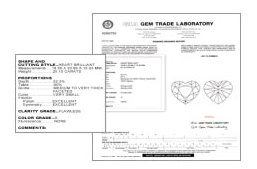
A diamond certificate is the blueprint of the loose diamond. The certificate, also known as a cert, grading report, or diamond dossier confirms the exact properties of your diamond.
The cert provides the measurements, weight, cut and quality of the diamond.
Most of our center stones (1/4 ct and larger) are certified by one of several major gem labs including AGS, GIA, EGLUSA, GCAL or IGI.
You can learn more about certificates in our Learning Center.
A title granted by the American Gem Society to jeweler members who have completed several advanced gemology courses and examinations.
Small grooves in a jewelry setting that help hold the stone in place. Used most frequently for wedding and anniversary bands, a channel setting will set the stones right next to each other with no metal separating them.
A flaw in a gemstone usually created by damaging contact with another surface or hard material.
The mechanism on the end of jewelry bracelets and necklaces that manually opens and closes to firmly connect the two ends and hold the jewelry in place.
A tiny flaw, in the form of a crack, inside a diamond. Very minor cleavages will not affect the brilliance of a stone. Major cleavages can damage the diamond's structural integrity.
A group of minute crystals, called pinpoints, which may form inside some diamonds. Very minor clouds are not visible to the naked eye and do not affect the brilliance of the stone or compromise its integrity.
This setting surrounds a larger center stone with several smaller stones. It is designed to create a beautiful larger ring from many smaller stones.
A silver-white metal, harder and stronger than iron or nickel. Used as an alloy in the making of steel and as a coloring material for many blue glasses which simulate gems.
A type of jewelry band featuring a rounded inside edge--as opposed to a sharper edge-to eliminate pinching and improve its comfort.
The presence or lack of blemishes on a stone's surface that define its appearance.
A small bruise, usually outlined by minute cleavages in a four- or six-sided pattern, commonly found on most diamonds after wear.
Copper is a soft metal often used in jewelry. It is used in making bronze, brass, and gold alloys.
That angle beyond which all incident light is reflected, without escaping from the stone. Ideal cut diamonds use these angles to ensure maximum reflectivity or brilliance.
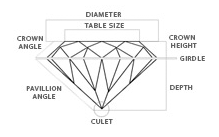
The upper facets of the diamond, above the girdle, leading to the table, or the top of a diamond.
The pavilion.
The facet at the tip of a gemstone. It may be polished in some stones. The stone cutter may choose to make the culet a surface instead of a point.
A mixed-cut diamond shaped like a square pillow.
One of the "4 C's," cut refers to the angles and proportions a skilled craftsman creates in transforming a rough diamond into a polished diamond. Based on scientific formulas, a well cut diamond will internally reflect light from one mirror-like facet to another, and disperse and reflect it through the top of the stone. This results in a display of brilliance and fire. Diamonds that are cut too deep or too shallow lose or leak light through the side or bottom, resulting in less brilliance and ultimately value.
You can learn more about cut in our Learning Center.
11 term(s)
De Beers conducts the mining of about 45% of the world's gem and industrial diamonds, and the marketing of the vast majority of all newly mined rough gem and industrial diamonds through associated companies.
Cut refers to the angles and proportions a skilled craftsman creates in transforming a rough diamond into a finished diamond. When a diamond is cut too deep, it will lose or leak light through the bottom or sides. This results in less brilliance and value.
The height of a diamond, as measured from the culet to the table.
The height of a diamond, as measured from the culet to the table.
The quotient derived by dividing a diamond's width by its depth. This formula is critical in determining a diamond's brilliance.
The width of a diamond or other gemstone at its widest part, the girdle.
A diamond is crystallized carbon. It is the hardest known natural substance. Diamonds grow in the earth more than 150 kilometers deep in the mantle and their growth rate may be highly variable depending on the local abundance of carbon, the temperature, the presence or absence of melt, and other factors. Many of the diamonds found at the surface of the earth or in mines are very old, perhaps 3 billion years. Diamonds are mined in their rough form and then cut and polished to reveal their brilliance.
Appraisals of diamonds. There are many recognized gemological labs that can grade your diamond for a fee.
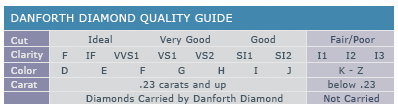
Use this Danforth Diamond Quality Guide to see which diamonds are carried at Danforth Diamond.
A diamond's width and height as they appear in the setting.
When light enters a diamond it reflects off the facets and the angles cut into the stone. This distribution of light is known as dispersion, or the display of the spectral colors.
5 term(s)
EGL USA is one of the largest and oldest independent gemological institutions focusing on gemstone certification and research.
A step cut gemstone that can be rectangular, square or even triangular, where the corners have been cut off for protection and easier prong setting.
Procedures or treatments, such as oiling and heating, which are typically part of the cutting and polishing processes to increase the diamond's qualities. For a stone to be certified, these must be permanent and must not compromise the natural beauty of the diamond.
A narrow band of platinum or gold set with a full or half circlet of diamonds and perhaps colored stones, given by husband to wife as a pledge of continued love, to mark the birth of a child, or a wedding anniversary.
A facet placed without regard to symmetry and that is not required by the shape of the diamond.
26 term(s)
Diamonds in this category have no internal inclusions. They are extremely rare and highly valued. These stones are perfect.
A girdle that has been cut with facets.
These are tiny surfaces polished onto a rough diamond that give a finished diamond its shape. The way light interacts with these facets affects a diamond's brilliance and sparkle.
Diamonds that simply fail to reflect a sufficient amount of light. In most cases, they are too shallow or too deep to meet the minimum standards of a good cut.
A very rare and expensive type of diamond that may appear blue, green or yellow. These are the only diamonds actually made more valuable because of their color.
Any diamond shape other than round; e.g., marquise, square, emerald, oval, heart and pear.
Diamonds in the D to Z colorless category that are so yellow that they transcend the scale and become a classification all to themselves. When bright yellow, they can be as valuable as D colorless diamonds.
Anything which damages the appearance of a diamond, and thus lessens the value - flaws, scratches, chips, etc.
A tiny fracture inside a diamond that may be feather-like in appearance. It is a separation or break due to either cleavage or fracture, often white and feathery in appearance. Most feathers are insignificant and do not visibly affect the brilliance or compromise diamond integrity. Also called a fracture.
Wispy, irregular white inclusions inside a diamond that was cut from a macle, or rough diamond.
Standardized parts of jewelry used in manufacturing and repair work, such as ear nuts, shanks, catches, lobster claws, settings, etc.
A type of inclusion, or internal flaw, particularly found in corundum.
Finish is used to describe the exterior of the diamond. If a diamond is well polished, it has a very good finish.
Often a term used instead of "dispersion," it is the variety and intensity of rainbow colors seen when light is reflected from a diamond.
A noticable white circle that looks like a fish eye, present in some poorly cut diamonds.
The name for certain settings that have the shape of a fishtail in the side of the setting.
An elongated cavity, usually the result of a cleavage opening to the surface of a diamond or gemstone.
Comfort fit is a type of jewelry band featuring a rounded inside edge, as opposed to a sharper edge, to eliminate pinching and improve its comfort. You can learn more about other styles of engagement rings and wedding bands in our Learning Center.
Thin diamond cleavages.
An imperfection in a diamond, visible through a ten-power loupe.
The top clarity grade in diamonds; without flaws; perfect.
When exposed to ultraviolet light, a diamond may exhibit a more whitish, yellowish or bluish tint, which may imply that the diamond has a property called fluorescence. The untrained eye can rarely see the effects of fluorescence. Diamond grading reports often state whether a diamond has fluorescent properties. Fluorescence is not considered a grading factor, only a characteristic of that particular diamond. A synonym for fire.
The term used to describe the four critical things to consider when buying a diamond: cut, color, clarity, and carat.
A crack on a diamond's surface. Also called a feather.
In diamonds, fracture filling entails a molten glass filling that improves clarity. You can get a lot more stone for your money buying fracture-filled diamonds; the problem is that the treatment isn't always permanent. Get all enhancements clearly stated on your bill of sale.
A gemstone with 58 facets.
17 term(s)
GCAL certificate of authenticity serves as verification of a diamonds quality. This certificate is issued by the Gem Certification and Appraisal Lab a respected authority in diamond grading.
One who completes recognized courses of study of gem materials and/or passes examinations that demonstrate his competence to identify and evaluate gem materials.
The scientific, historical and legendary study of gem materials, as distinct from all the minerals scientifically studied in mineralogy.
A naturally occurring mineral found in the rocks of the earth, the chemical composition and internal atomic structure of which make it suitable for jewelry use: color, clarity, hardness, rarity and availability.
The Gemological Institute of America (GIA), an industry leader in diamond grading.
The band around the widest part of a diamond. It is usually the part of the diamond to which the setting is adhered.
The proportion of the girdle to the rest of the stone. Too thin a girdle leaves the stone susceptible to cracks and breakage, while a girdle too thick will have reduced brilliance and fire.
A yellow-colored precious metal that is very soft when pure (24 Kt.). Gold is the most malleable (hammerable) and ductile (able to be made into wire) metal. Gold is alloyed (mixed with other metals, usually silver and copper) to make it less expensive and harder. The purity of gold jewelry is measured in karats.
This category represents the top 35% of diamond cuts. While they may still be quality diamonds, they will show a significant lack of brilliance. They are, however, considerably less expensive than the grades above them.
The process of evaluating a diamond's characteristics (most commonly its cut, color, carat and clarity) to determine its quality and value.
The term used to describe an incremental change in the size of multiple gemstones within the same setting.
Unit of weight in the metric system, based on the weight of one cubic centimeter of water. One kilogram, or 1000 grams, = 2.2046 pounds. (31.103 grams = 1 Troy ounce).
Gold alloy containing a relatively high proportion of silver. The higher the karat or quantity of gold, the better the green gold color.
These can be considered internal flaws, and can often be seen only by rotating the diamond very slowly. They can appear and disappear almost instantaneously. They appear as small lines or planes within the diamond.
A thin ring, inconspicuous in appearance, worn on a finger in front of a valuable ring, to prevent the latter slipping off. Guard rings are often worn in pairs, with or without stones, on each side of a wedding ring.
This setting is predominantly used for men's jewelry. The band is one continuous piece that becomes thicker at the top. The top is dome shaped and the stone is inserted in the middle.
10 term(s)
A type of inclusion in a gem, resembling a hair.
In reference to gems and minerals, the resistance offered to abrasion or scratching. Minerals are measured and numbered on a relative hardness scale, where the intervals between the numbers are very different (e.g. a diamond, the hardest, is far harder than the next mineral down the list).
These precious metals share the exquisite beauty of mined metals, but are 100% recycled through the environmentally-friendly process of refining precious metal scrap. Learn more about HARMONY at Danforth Diamond.
The main part of a setting, including the "basket" and prongs, which holds the diamond in place.
The shape of the setting's head, usually determined by the shape of the stone.
The range of sizes of a diamond that can be mounted to a head. It is usually determined by carat weight.
A pear-shaped diamond with a cleft at the top.
The estimated size of a diamond, measured vertically from the top.
The part of the clasp that physically moves to lock it in place.
A descriptor of a diamond's color that indicates whether it is pure or shows the presence of another color.
11 term(s)
These diamonds contain significant inclusions that are visible both under magnification and to the naked eye. Because "I" grades have inclusions that can be seen with the naked eye, we do not recommend that you buy these diamonds for an engagement ring.
An ideal cut diamond has the best combination of angles that allow light to enter the diamond and be reflected back, to create the best combination and brilliance and fire. Ideal cuts often create perfectly aligned arrows and heart patterns that can be seen under magnification.
IGI Diamond Report describes the diamonds characteristics including the carat weight, cut, color and clarity. Each diamond is analyzed by several gemologists who use state of the art equipment to provide the details of the report which are based upon an internationally accepted system.
The Independent Gemological Laboratories, an industry leader in diamond grading that specializes in grading jewelry set with large diamonds.
This setting is more intricate than others in that it surrounds the stone to make it appear larger. The metal that surrounds the stone is usually faceted or polished white gold to enhance the diamond.
Any flaw, crack, carbon spot, cloud or other blemish of any sort observable in a gemstone, when the latter is examined by a trained eye under a 10-power magnifier.
Identifying characteristics in a diamond, usually in the form of a blemish, scratch, air bubble or any other foreign material either inside the diamond or on its surface. Often referred to as "nature's fingerprints." They are what make a diamond so unique, as a fingerprint does for a person. These birthmarks are measured on a scale of perfection known as clarity. Some common names of inclusions include cloud, crystal, pinpoint and feather. The position of inclusions can affect the clarity of a diamond and therefore the value.
Stress in a diamond or gemstone resulting from inclusions or other structural irregularities, visible through the polariscope.
Iridium is a metal related to platinum. Iridium and platinum are frequently alloyed together, as the iridium increases the workability of the platinum.
A diamond shape classification, crystals of irregular shape with broken parts.
1 term(s)
An item of jewelry findings, soldered or screwed to a piece of jewelry, to form, with a pin, a hinge for the pin with which the piece is fastened to the clothing of the wearer.
2 term(s)
Indicates the amount of pure gold present in a metal. 18K yellow gold consists of 75% gold and 25% other metals; these are usually copper and silver. 14K yellow gold consists of 58% gold and 42% other metals.
A tiny crystal on the surface of a diamond. Very minor knots are not visible to the naked eye and do not affect the clarity of the stone.
9 term(s)
A tiny surface hole in a diamond, usually the result of drilling into the stone to remove an internal inclusion.
A dull, fireless diamond.
A technique for improving the appearance of some flawed diamond; hydrofluoric acid is used to reach inclusions open to the surface or from which fractures or cleavages radiate to the surface; thus unsightly flaws may be "leached" white.
13 term(s)
Palladium: Stronger than white gold, palladium is a pure white metal from the platinum family.
Yellow gold: The most popular gold alloy. An alloy of gold, silver, copper and sometimes zinc.
Precious metal is a rare metallic chemical element of high economic value that is used for art, jewelry and coinage. Chemically, precious metals are less reactive than most other elements, have high luster, are softer and have higher melting points than other metals. The most popular metals for jewelry are:
Yellow gold: The most popular gold alloy. An alloy of gold, silver, copper and sometimes zinc.
White gold: An alloy of gold, with nickel or palladium.
Palladium: Stronger than white gold, palladium is a pure white metal from the platinum family.
Platinum: A white metal, and one of the hardest and more popular metals used in engagement rings today.
Silver: The whitest of jewelry metals, harder than gold, softer than copper, more malleable and ductile than any metal except gold.
Measuring instrument in which the object to be gauged is brought up the end of a screw, which has a head graduated on its rim, from which the measurement is read. Calipers are made in inches, thousandths and ten-thousandths; and in metric measure in millimeters, tenths and hundredths.
Unit of length, or one thousandth of a meter. A millimeter is .03937 inch.
This cut has both step cut and brilliant cut facets. Mixed cuts combine the beauty of the emerald cut with the sparkle of the brilliant cut.
A scale developed by Friedrich Mohs to quantify the hardness of minerals and gemstones. It utilizes a scratch test to rate diamonds on a scale of 1-10 (the higher the number, the harder the mineral will be).
A hollow form that gives shape to metal in its molten state.
The method of holding gemstones in place in jewelry. Settings, prongs, channels, etc., are mountings.
An abbreviation for "manufacturer's suggested retail price," a guideline provided by the manufacturer so that retailers may determine the value and set the retail price of items.
7 term(s)
U.S. Federal law, enacted in 1906, controlling quality marks on articles made in whole or part of gold or silver; 1961 amendment requires a registered trademark (the mark of a manufacturer, importer, wholesaler or retailer registered with the United States Patent Office) to accompany a quality mark.
A small edge of rough diamond that is left unpolished on the surface of the stone. Very minor naturals are not visible to the naked eye and do not affect the clarity of the stone or compromise its integrity.
A long, tiny crystal on the surface of a diamond. Very minor needles are not visible to the naked eye and do not affect the brilliance of the stone or compromise its integrity.
The Northwest Gemological Laboratories (NGL), an industry leader in diamond grading.
A small cut, notch, or indentation on the girdle or a facet edge.
An elemental metal of important use in the jewelry trade. Pure nickel is white, hard, ductile and malleable. The principal use of nickel, when alloyed with gold, makes the latter harder, more ductile and paler; it replaces silver in white gold; it acts as a grain refiner, producing smooth surfaces after annealing or casting.
A silvery, soft, ductile metallic element used in steel alloys.
7 term(s)
A major problem in gemstone cutting. An off center culet seriously affects the symmetry of a stone.
A color grading term for diamonds that display a more or less distinct tint of undesirable color, usually yellow, when viewed through the table by an experienced eye.
A common procedure for gemstone color enhancement. The treatment is not permanent and should be disclosed at point of purchase.
The term for a diamond that contains excessive inclusions and will not allow light to pass through the stone.
A hard, white metallic element of the platinum group; possibly the heaviest element known.
An even and perfectly symmetrical elliptical shape; basically, similar to Round, but elongated.
The forming of an oxide from base metals such as the copper in sterling silver or a karat gold alloy combining, through heat, with oxygen and forming a coating of copper oxide. Not to be confused with the discoloration of silver by sulphur and its compounds.
19 term(s)
A white metallic element, used in dentistry, jewelry, and chemical and electrical equipment. Used to make white gold, without causing the stress corrosion that can happen in nickel alloys.
Many small gemstones placed in tapered holes creating a "pavéd" appearance. Usually diamonds are set in white gold to create a sparkled finish.
The bottom part of a stone, under the girdle, measuring to the culet.
A hybrid cut, combining the best of the oval and the marquise, the shape is similar to a teardrop or pear.
A smooth, lustrous, variously colored deposit, chiefly calcium carbonate, formed around a grain of sand or other foreign matter in the shells of certain mollusks and valued as a gem.
A unit of Troy weight, used for weighing precious metals. The pennyweight contains one-twentieth of an ounce. Abbreviated "dwt."
Total cost of a gemstone is equal to the carat weight X the per carat cost.
Tiny, speck-like crystals inside a diamond. Several of these together may form a cloud in the stone that appears to be hazy.
A white metallic element, popular in jewelry making. In it's pure form, it is soft and malleable. Hardness is noticeably affected by rolling and heat-treating, also by the presence of impurities, even in small amounts. Alloys containing 10% iridium or 5% ruthenium possess hardness and working qualities highly desirable in jewelry making, and are known as "hard platinum."
A gold alloy of the same fineness as marked, or perhaps with a small tolerance such as .003. Not less than 14K gold.
To easily quantify carats, jewelers assign 100 "points" to each carat and discuss weight based on portions of those points. A 50-point diamond, for instance, is the equivalent of a half-carat.
An instrument for studying the properties of, or examining substances in polarized light.
The smoothness of the facets of a diamond. Smoother facets reflect light more acutely and increase brilliance.
Cut refers to the angles and proportions a skilled craftsman creates in transforming a rough diamond into a finished diamond. A poorly cut diamond can be either cut too deep or too shallow. A deep or shallow cut diamond will lose or leak light through the side or bottom. This results in less brilliance and value.
Metals prized because of chemical and physical properties such as resistance to corrosion, hardness, strength and beauty. Common precious metals used for making jewelry are platinum, gold, silver and palladium.
The Princess-cut is a very attractive square or sometimes rectangular cut, and it has some of the sparkle of a Round brilliant cut. Because of its design, this cut requires more weight to be directed toward the diamond's depth in order to maximize brilliance. It may have either 50 facets (21 crown, 4 girdle, 25 pavilion) or 58 facets (21 crown, 4 girdle, 33 pavilion), depending on how the pavilion is cut. Princess shapes of high cut quality usually have a table percentages between 60-75% and a total depth percentage between 65-80%.
Consists of four or six prongs that cradle the stone. Because this setting allows the maximum amount of light to enter a stone from all angles, it can sometimes make a diamond appear larger and more brilliant than its actual weight.
The proportions of a diamond are very important, so that the maximum amount of light be reflected off and out of a stone. Proportion is the relationship between the angles of the facets of the crown and the pavilion.
1 term(s)
A square cut diamond with 96 facets: 49 brilliant style, 21 crown and 24 pavilion. This differs from a Princess, which has either 50 facets (21 crown, 4 girdle, 25 pavilion) or 58 facets (21 crown, 4 girdle, 33 pavilion), depending on how the pavilion is cut.
11 term(s)
A 70 facet rectangular or square shaped diamond with step and scissor cuts on the crown, a brilliant cut on the pavilion and emerald cut corners.
Operations performed to extract metals in pure form from masses containing other metals or impurities.
Refraction is when light enters a medium with a different optical density (like a gemstone), and the light is bent at an angle (and also changes its speed).
A white metallic element of the platinum group, commonly used as an electroplate finish on white gold to improve the white color.
A gold bridge with ears that clamp inside a ring that has to be oversized to go over an enlarged knuckle. Used to keep the ring from turning on the finger, or to decrease the size of a ring without cutting and re-soldering it.
The term for any ring prior to gemstone mounting.
Proper ring size is based on the diameter of the wearer's finger and the size of her/his knuckle. The most common ring sizes range from 4 to 13. A size 4 ring has a circumferance equal to 46.5mm or 1-13/16 inches. There are many ways to determine a ring size.
A grainy or perforated girdle surface, often with nicks.
A cut of diamond that is round and contains 57 facets. This is the most popular shape for engagement rings.
A white metallic element of the platinum group, used mainly as a hardener for platinum or palladium. Melting point above 2400º C; specific gravity 12.2.
23 term(s)
A finish on jewelry given by dulling the polish by scratch brushing, sandblasting or chemical-treatment, producing a surface of metallic color, but with a soft, pearl-like luster instead of bright finish. Good to show off different colors of metals when jewelry uses multiple colors.
The purity of a diamond's color, generally indicating an absence of brown or green hues in the stone.
Scintillation is the intense sparkling in a diamond as it moves. Black and white sparkles of scintillation show well in flood lit or office lighting environments where fire can be totally absent. Under pin point or spot lights, fire also adds to scintillation. Ideally a diamond has many pleasing flashes spread across the surface of the stone, with few dull dead patches.
A class of jewelry-shop waste, cuttings of precious metals, large enough to sort for re-melting; differentiated from filings, sawdust and other small waste that has to be sweep-smelted and refined to recover it for use.
A mounting that is set with only its small or sidestones but has not yet received its center or main stone.
The second and largest of the three categories into which gemstones have been divided by traditional usage. Stones such as topaz, garnet and amethyst are regarded as semi-precious, rather than precious, for relative softness, inferior brilliance, comparative abundance, unfamiliarity or fashion.
The setting holds the stone in place. The combination of a shank and head make up a ring. Some popular settings are the Prong, Peg, Chanel, Bezel, and Pavé.
Same as prong metal. The most popular and traditional setting, often referred to as a "Tiffany" or classic or claw setting. This setting normally has 4 or 6 individual claws of metal that hold a stone in place. You can learn more about settings in our Learning Center.
Cut refers to the angles and proportions a skilled craftsman creates in transforming a rough diamond into a finished diamond. When a diamond is cut too shallow, it will lose or leak light through the side or bottom. This results in less brilliance and value.
The part of a ring that fits around the finger. The combination of a shank and head (or setting) make up a ring.
Refers to form or appearance of a diamond. Whether the diamond is round, triangular, square, marquise, pear, oval or heart shaped.
These two grades of slightly included diamonds contain inclusions that are evident under 10x magnification and may be seen by the naked eye in some cases (generally in SI2 diamonds). If your goal is maximizing size and/or affordability, look at S1 and S2 diamonds. Many of these stones are what professionals call "eye-clean," meaning they have no visible inclusions.
A stone set as part of a group encircling a center stone.
A metallic element, used in jewelry, coinage, dentistry, photography, etc. It is the whitest of metals, harder than gold, softer than copper, more malleable and ductile than any metal except gold, and probably the best conductor of heat and electricity.
A simple cut of 17 - 18 facets, given to small diamonds.
Uniting pieces of metal by melting between them another kind of metal.
A single-diamond engagement ring.
To help ensure the integrity of our supply chain, all diamonds sold by Danforth Diamond are either covered by the Kimberly Process or, they come from our own brand of Recycled or Canadian HARMONY Diamonds™.
Recycled HARMONY Diamonds™ -
To help reduce the industry's reliance on environmentally damaging mining practices, Danforth Diamond is proud to participate in the acquisition, certification, and reintroduction of previously used stones back into the diamond industry.
Recycled HARMONY Diamonds™ are natural diamonds which come through our refining customers and represent diamonds that at one time were set into jewelry and then sold by the consumer to our customers throughout the country. We buy these stones, have them certified, and then make them available to you at highly competitive pricing.
Canadian HARMONY Diamonds™ -
Certified and conflict free, these diamonds are responsibly mined, cut and polished in the Canadian North. Their production and sale are subject to strict standards, set out by the Canadian Code of Conduct, CanadaMark™, and the Government of the Northwest Territories, designed to protect the Arctic environment, mine workers and local employees.
Known for their sparkle and clarity, Canadian diamonds rank among the most spectacular diamonds currently available.
Learn more about these eco-friendly diamonds and make a choice that will help protect the Earth and its people!
The result of light entering a diamond and reflecting repeatedly throughout the stone. Also called brilliance or fire.
A property of any substance, its weight in relation to an equal volume of distilled water at 4º C. It is one of the most important properties to aid in the determination of a gem.
An instrument used in gem identification.
The cut has rows of facets that resemble the steps of a staircase. The emerald cut and the baguette are examples of the step cut.
Symmetry refers to the angles at which the "facets" (the stone's smooth, angled surfaces) align. Proper symmetry reflects light from one surface to another repeatedly throughout the diamond (allowing as little light as possible to escape). Excellent symmetry of a well cut and well-proportioned diamond can have a great effect on the diamond's brilliance and fire. Grading reports will often state the diamond's symmetry in terms Excellent, Very Good, Good, Fair, or Poor.
12 term(s)
The term used to describe the width of the table facet, often expressed as a percentage of the total width of the stone. The table should be between 53% and 67% of the girdle diameter.
The largest facet on a gemstone. The table is on top of the crown and allows refracted light to escape, creating brilliance.
Increasing the hardness of metal by gradual heating to stages less than annealing heat.
A tension set diamond is held in place by the pressure of the shank's metal, which is designed to "squeeze" the stone.
A silvery gray, light, strong metallic element found combined in ilmenite and rutile and used especially in alloys (as steel) and combined in refractory materials and in coatings.
A scale designed to measure color intensity in a diamond. Values range from "light" to "dark."
The total diamond carat weight of all the stones in a piece of jewelry.
The mark of a manufacturer, importer, wholesaler or retailer registered with the United States Patent Office. Registration remains in force for 20 years; may be renewed for like periods.
A triangular shaped diamond with 50 facets. Trillions are commonly used as side stones.
A unit of Troy weight, long used for weighing precious metals. The ounce contains 20 pennyweights each of 24 grains.
An alternative to Sterling Silver, TruSilver™ is a sterling silver alloy which is 4 to 5 times more tarnish resistant than Sterling Silver but costs the same as Sterling and shares the same hardness values and metal color.
An irregularity in a diamond's crystal structure that appears as a line inside the stone. Minor wisps are not visible to the naked eye and do not affect the clarity of the stone or compromise its integrity.
1 term(s)
A cleansing agent dissolved in a solution and vibrated at frequencies higher than the those audible to the human ear. At such vibrations, foreign matter and dirt are dislodged while the jewelry is being cleaned.
5 term(s)
A prong setting designed to protect the fragile points of a diamond. The v-end shaped prong wraps around the point of fancy diamond shapes such as princess, emerald, marquise and pear.
These diamonds reflect much of the light that enters the stone. They usually trade in some of their brilliance for added size.
A test for metals in which a diamond pyramid is pressed into the metal by a load of 5-120 kilograms.
These two grades of Very Slightly Included Diamonds have minute inclusions that are not visible to the naked eye and are difficult to see under magnification. 10X magnification is required to clearly see an inclusion. VS clarity diamonds are a good choice for someone wishing to balance high quality with relative affordability.
These two grades of VVS Diamonds have minute inclusions that are extremely difficult to detect even with 10x magnification. These diamonds are excellent choices as their inclusions are minor and invisible to the eye. These diamonds offer cost savings without sacrificing too much in terms of clarity.
5 term(s)
A device for forcing molten wax into a rubber or metal mold in order to make a wax pattern. Pressure for the wax injection is supplied by compressed air or hydraulic pressure.
Well cut diamond proportions ensure the maximum compromise between fire and brilliance. When light enters a properly cut diamond, it is reflected from facet to facet, and then back up through the top, exhibiting maximum brilliance, fire and sparkle.
A diamond color grade approximately equivalent to GIA grades F, G, H, and AGS grades 1 and 2.
An alloy of gold, with nickel or palladium.
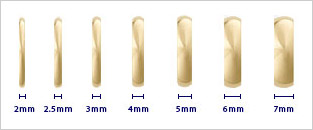
The width is the horizontal size measurement of a piece of jewelry or gemstone. The width of a ring or band is measured across the widest area, over the top of the ring, as shown here.
2 term(s)
A color-grading term measured by grade Z on the GIA scale or grade 10 on the AGS scale. Stones that are deeper than Z or 10 are designated fancy yellow.
The most popular gold alloy. An alloy of gold, silver, copper and sometimes zinc.
1 term(s)
A bluish-white metal, melting point, 787º F; used in gold alloys to lower the melt temperature and improve malleability.