Win Up to 5 Pieces of Jewelry and a 1.00ct Diamond in Danforth Diamond’s Super 6 Sweepstakes September 21, 2011
Posted by Jill Renee in : Buying Diamonds, Buying Engagement Rings, Diamond Jewelry, Diamonds, Engagement Rings, Jewelry, Wedding Jewelry, Win Diamond , 44comments Danforth Diamond, your online engagement ring expert, is launching a facebook sweepstakes beginning September 19, 2011. Five lucky winners will receive fun and elegant silver or gold pieces from Danforth Diamond’s jewelry collection. A grand prize winner will receive a one carat cushion cut diamond!
Danforth Diamond offers a wide selection of classic solitaire, three stone, antique and designer engagement rings which are all offered in 14K gold, 18K gold, platinum and palladium. Even with this great selection of engagement rings, Danforth Diamond knows the importance of educating their customers on metal properties, the 4 C’s of diamonds and other tricks of the trade. Now, with a presence on Facebook, Danforth Diamond provides a social platform for customer’s that want to share their jewelry knowledge and buying experience
“Our goal with the extensive Learning Center on Danforth Diamond is to educate our customers on metals and diamonds so they can purchase with confidence,” said Jill Renee, president of Danforth Diamond. “Creating a vibrant facebook community will create a platform where our fans become teachers. We can’t think of a better way to create an excited fan base of jewelry fanatics than by giving away five pieces of jewelry and a 1.00 carat cushion cut diamond with almost perfect criteria!”
The one carat cushion cut diamond has an ideal cut with G color and VS1 clarity. There is no fluorescence, and it is GIA certified. The retail value of the diamond is $5,585. The first five prizes include a sterling silver bracelet with butterfly charms valued at $150, a sterling silver bracelet with three stretched oval gold dust links valued at $185, 14K two tone gold hoop earrings valued at $460, a sterling silver bracelet with ladybug charms valued at $230 and a 14K white gold diamond cluster necklace valued at $600. Drawings will occur every Monday for 6 weeks starting on October 10th! The grand prize winner will be drawn on November 14th and the winner will take home the diamond! To view all of the prizes please visit danforthdiamond.com.
Drawing will occur every Monday for 6 weeks, starting on October 10th! The grand prize winner will be drawn on November 14th and the winner will take home the 1 carat diamond!
To view images of the prizes, please visit http://www.danforthdiamond.com/super-6-sweepstakes.
GOOD LUCK EVERYONE!! Jill Renee
Holidays are a Perfect Time to Get Engaged! December 1, 2010
Posted by Jill Renee in : Buying Diamonds, Buying Engagement Rings, Buying Jewelry, Canadian Diamonds, Diamond Jewelry, Diamonds, Eco-Friendly Jewerly, Engagement Rings, Holiday Proposals, Proposing Marriage , add a commentThe holidays are a perfect time for couples to get engaged. Usually, the holiday season brings visits from far away relatives and friends and they present a great opportunity to share the happiness of being newly engaged and to show off the engagement ring!
This season some celebrity couples have jumped on the holiday engagement bandwagon. Prince William and Kate Middleton kicked off the season followed by Vanessa Minnillo and Nick Lachey and Jessica Simpson and Eric Johnson. Much has been made about the Jessica and Nick engagements following one another so closely but I say so what. Let’s all try and play nice and wish them both some happiness. Poor Jessica has been under the microscope with every relationship she has had since the break up with Nick. If she has found some happiness with Eric, that is great news! I just can’t stand these nasty bloggers who seem to enjoy watching other people suffer. By the way how do they know who paid for the engagement ring and why do they care?
The holidays are supposed to be about good will so celebrating a happy occasion like getting engaged is a perfect fit. If you are planning on getting engaged this holiday season be sure to leave plenty of time to order the engagement ring and eliminate any stress involved with such an important purchase. Be sure to read up on choosing the right engagement ring settings and picking a perfect diamond. Once you have done all your homework pick a good time to pop the question and have some fun!
Tips on Choosing a Diamond Ring June 18, 2009
Posted by Jill Renee in : Buying Diamonds, Buying Engagement Rings , add a commentOnce you have made the big decision and have decided to ask the one you love to spend the rest of her life with you. Now you must go on a quest for the perfect ring. It may seem like a daunting task but it won’t be, if you keep a few things in mind. You will find the perfect ring in no time.
First, you must keep in mind your loved ones choice in jewelry and also your budget to find the perfect ring that will fit your needs. Take a look at the jewelry she wears now to get an idea of what type of style it is and also does she prefer silver or gold. The type of jewelry she prefers whether it is bold or vintage will also give you an idea of what type of ring she might prefer.
Another thing to consider is the shape and setting style. The number one choice chosen by most brides to be are round diamonds. Other styles to choose from include; oval, pear-shaped, square and heart shaped. There are also different settings to choose from, such as; a solitary diamond set alone in a band or a band with stones embedded in it. The type of rings she wears now may give you some clues about what style she would like.
The size and shape of her hands and fingers will also make a difference in which style and type of ring will suit her best. If she has short fingers an elongated diamond such as an oval or marquise can make her fingers appear longer. If she has long fingers a wideband ring will make her fingers appear shorter. Bold ring styles look very nice on long fingers. If she has larger hands a small delicate engagement ring could actually look smaller on her finger.
There are also several different precious metals to choose from, including, gold, silver, platinum and palladium. Most women have a preference of which type of metal they prefer their jewelry to be made of. Some women prefer the “white” look of white gold, platinum and palladium. On the other hand, some women prefer gold. If you notice the jewelry she wears now you should be able to determine which metal she would prefer for her engagement ring.
If you are unsure of what exactly she would prefer you can always try to be subtle and get hints from her on what she likes. Another good idea is to enlist the help of a family member or a close friend of hers to help you make the choice. Make sure you choose someone who knows her likes and dislikes and also someone who can keep the ring a secret. You can also browse online or in your local shopping mall to get some ideas.
Choosing an engagement ring can seem like an overwhelming process. If you pay close attention to what your loved one says and the jewelry she wears you will make a perfect choice. You will find the perfect diamond and setting that she will cherish forever.
Diamond Cutting May 10, 2009
Posted by Jill Renee in : Buying Diamonds, Diamond Jewelry, Diamonds , add a commentWhen a diamond is first extracted from the earth it looks just as any other pebble or piece of rock you may have picked up on a beach and thrown into the sea. Many people never realize the fiery, brilliant stone they are wearing was formed at least 50 miles below the surface of the earth under the most intense pressure and extremes of temperature which compressed humble carbon atoms into a particularly strong atomic formation which gives diamonds their quality of strength and fiery beauty.
In order to bring this beauty and brilliance to the fore, the rough diamond must be cut and polished and how this process is performed will impact directly on how a diamond will look; a wrong cut will destroy the value of a stone and diminish its beauty while a good cut will enhance and amplify one of the world’s most beautiful gemstones and certainly, the most valuable.
Cutting a diamond is a highly skilled art form and requires a superb craftsman to perform the process. For some, cutting a diamond is a highly stressful experience, even for those watching – one slip, one unnoticed flaw in the planes of the diamond structure or a mistake made in the choice of cut to apply and the stone can become a worthless piece of rock; so important is the cutting process that over 40% of the value of the finished stone is applied by the cutting process.
There are many different types of diamond cut and which is applied to a rough diamond will be determined by the overall size, weight and shape of the rough diamond as well as the intended use of the stone – many diamonds never become part of a jewelry collection and instead, end up being used in industrial processes using their hardness for forming the points of drill bits for instance.
Common diamond cuts include:
- Round
- Princess
- Marquise
- Emerald
- Oval
- Heart
- Pear
By far the most popular cut is the Princess Cut, usually with the stone used as the centerpiece for a solitaire ring, very frequently the choice for an engagement ring. The Princess Cut provides a sparkling effect but uses a more contemporary square style. The Emerald cut provide an elongated rectangular shape which together with the Pear Cut look perfect on long fingers; the shape of the diamond you choose will be influenced by a sense of style and also the size of your lady’s hand and fingers. Using an elongated diamond shape (Pear or Emerald) will look better on a hand with short fingers because the shape will accentuate them; a long fingered lady is fortunate in that she can get away with any bold style of diamond ring!
The diamond cut is the only man-made part of the process which directly impacts the value of a stone – the other factors are the Color, the Clarity and the Carat (weight) which with the Cut are known collectively as the “Four C’s“. Combined together, the Four C’s are used to classify and grade a diamond for quality and in turn, to determine its value.
Read more about Diamond Cuts.
Colored Diamond Information March 11, 2009
Posted by Jill Renee in : Buying Diamonds, Diamonds , add a commentWhat is a colored diamond?
When Ben Affleck proposed to Jennifer Lopez, the act generated the expected amount of media attention. However the majority of that coverage wasn’t focused on the total number of the couple’s prior marriages, or that “Bennifer” name smashup the couple had been adorned with. No, the focus of the majority of mass speculation was the color of Jennifer’s diamond.
They Come In Pink?
Ms Lopez’s engagement ring was topped with a tremendously large 6-carat pink diamond. The word that people seemed to cling to was pink. The realization that diamonds come in colors started to spread, contradicting everything taught about diamond color: the closer to clear, the more valuable the diamond. Was Jennifer’s “pink diamond” actually a diamond?
Are They Still Diamonds?
In a word, yes. While the common color grading scale used for diamonds runs from D (completely clear) to Z (obviously yellow) there is an entire subset of diamonds which fall beyond the Z rating into the umbrella grade of “Fancy.” Fancy diamonds still hold all of the other characteristics of a traditional white diamonds – the hardness, the technical measure of clarity, the cut, and carat are all the same.
A Scale All Their Own
Colored diamonds that fall outside of the white grading scale, still have to have a subjective color grade assigned to them. However, the grading scale for colored diamonds is considerably easier for the layman to understand. Colored diamonds with the faintest hints of color are given a grade of Faint. Lightly colored diamonds are either Very Light, or Light. The bolder colored diamonds, your truly fancy gems, are graded along a scale ranging from Fancy Light to Fancy Dark, with Intense, Vivid, and Deep breaking up the middle.
A Stone of Many Colors
As you might have guessed, pink isn’t the only color for diamonds. The infamous, and rumored to be cursed, Hope Diamond is a 45.52 carat dark grayish blue diamond. Canary diamonds are a brilliant yellow. Both brown and black diamonds are both real and growing in popularity lately. Other colors include orange, red, green, and purple. According to the Gemological Institute of America and the International Gemological Institute, there are 27 official hues which span the color spectrum, and there are diamonds to fill each of those hues.
Not to Get Too Technical
How those diamonds gain those hues is a bit of a technical process. Essentially, when the diamonds are forming from pure carbon, the molecules arrange themselves into a cage called a crystal matrix. As the diamonds are crushed under the earth’s pressure, that matrix closes in on itself. Occasionally, during that process, atoms from other elements such as boron, nitrogen, or hydrogen, will be trapped inside of those diamonds as their respective matrices close. The end result is the colored diamond. As one would rightly assume, when multiple gases are trapped in the diamond, you get diamonds of blended colors, like pink champagne diamonds.
Still Really Rare
While color is certainly one reason why people prize fancy diamonds, it’s certainly not the only one. Fancy diamonds are exceptionally rare. Colored diamonds, with a Fancy or deeper color grade, account for a mere 1.8% of the entire world’s diamonds. When that percentage is broken down by color, those percentages get even smaller. Canary diamonds, diamonds which are known for their brilliantly yellow hue, account for less than 0.1% of the world’s diamonds. Factor in the other common diamond factors – the size of the stone, the inherent shape, and the sense of clarity, and colored diamonds of significant size and quality get even rarer still.
Why Choose a Colored Diamond?
Colored diamonds aren’t for everyone or even for every type of jewelry. However, they do have some very strong selling points. The rarity of colored diamonds makes them special. The variety of colors means that colored diamonds can be used to convey not only the emotions associated with a traditional diamond, but also to cater to the specific tastes of the recipient. It’s those strengths that allow colored diamonds to fill jewelry niches that traditional white diamonds could not. In the end, a colored diamond provides a new and unique spin on a familiar and classic idea.
Understanding Carat Weight March 10, 2009
Posted by Jill Renee in : Buying Diamonds , add a commentOne of the first questions asked about a diamond is “How many carats is it?” And it’s a perfectly appropriate question. Of the four graded aspects of a diamond, carat weight is the easiest to translate into understandable terms. To put it simply, bigger equals bigger.
Carat isn’t a measure of size, though. Carat, or more correctly, carat weight, is a measure of mass, similar to the gram. In fact, five carats is exactly one gram.
As one would expect, when a diamond’s carat weight goes up, so does the size and the price. However, the price doesn’t rise on an even grade. The purchase of two half carat diamonds would be less expensive than a single one carat diamond, despite the overall mass being the same. This price difference is typically based on the rarity of larger stones and extends logically. You wouldn’t expect a twenty carat diamond to be priced the same as twenty one carat diamonds of similar cut, color, and clarity, would you?
The upside to smaller diamonds being less expensive is often capitalized on by the three stone engagement ring, in which a large center stone is flanked by two smaller diamonds. This tactic not only allows a diamond ring to be sold with a high carat count at a low cost, but plays upon the way the human eye compares based on size.
Understanding a Diamond’s Cut February 23, 2009
Posted by Jill Renee in : Buying Diamonds , 1 comment so farWhen discussing a diamond’s unique qualities, the term diamond cut does not refer to round, princess, or pear. We call those shapes. No, the quality “cut” is addressing the degree at which a diamond’s pavilion is angled, the relation of the diamond’s table to its overall width, and the relationship the depth of the diamond from the edge of the table to the pavilion.
Though that explanation seems overly complicated, it’s also quite important. A diamond’s cut determines how light reflects within and out of the diamond. The better the cut, the more light the diamond will reflect back out. The cut directly influences the diamond’s brilliance (reflected light) and fire (reflected hues), and so is a rather important quality. For lack of a better term, a poorly cut diamond will refuse to shine.
Thankfully, the American Gem Society and the Gemological Institute of America have come up with a much easier grading scale that sums up how well a diamond is cut in plain English.
The Ideal Cut
As the name suggests, a diamond with a cut graded as ideal is the best cut available. The Ideal cut strikes a strong balance between brilliance and fire, and sends most of the reflected light out back through the top of the diamond. These cuts are the top 15% of all diamonds.
The Very Good Cut
Slightly less reflective than an ideal cut, the Very Good cut diamonds tend to be slightly larger in size, which makes them an economical trade off. These diamonds represent the top 25% of all cut and polished diamonds and they still reflect much of the light they catch.
The Good Cut
Diamonds described as Good is where the cut starts to have a noticeable effect on brilliance. When viewed under optimal lighting, Good diamonds will reflect a good bit of light, however, light which is shined at them off center will often end up being reflected out of the diamond’s pavilion because it is either too shallow or too deep. The obvious upside to these diamonds is they are noticeably less expensive than the grades above them.
Fair and Poor cut
These diamonds do not reflect a sufficient amount of light, and are not sold at Danforth Diamonds.
The Four C’s of a Diamond – Clarity January 30, 2009
Posted by Jill Renee in : Buying Diamonds , add a commentOne of the telling qualities of a cut and polished diamond is clarity. The gemstone’s near transparency has done a great deal to contribute to both the sense of beauty and the associated value of the diamond.
But how clear is a diamond, really?
The answer, like color, varies from diamond to diamond. Though the gems by and large maintain an overall sense of clarity, diamonds do tend to have minor internal imperfections, known affectionately as birthmarks. Because many of these birthmarks are too small with the naked eye, diamonds have a clarity rating similar to the color, which can seem abstract at first glance.
Clarity Guide
- F – IF (Flawless to Internally Flawless) – these diamonds are as clear as a diamond can be.
- VVS 1 and 2 (Very Very Slightly Included) minute imperfections that are difficult to detect by a trained professional at 10x magnification.
- VS 1 and 2 (Very Slightly Included) as the name might suggest, these diamonds have tiny imperfections that are invisible to the naked eye and still difficult to see under magnification, essentially requiring 10x to make them out. Probably the sweet spot in balancing affordability with clarity
- SI 1 and 2 (Slight Included) The difference between SI1 and SI2 is largely the naked eye. Both have birthmarks that readily evident under magnification, however, the SI2 can occasionally have birthmarks which are visible to the untrained and unaided observer.
- I 1, 2, and 3 – (Inclusions) These diamonds have obvious birthmarks which are easily observed by the naked eye.
Birthmarks Make for Unique Diamonds
Just like a finger print, no two diamonds will have the same set of birthmarks. When a diamond is certified, these birthmarks are noted in a “plot” which can be used to uniquely identify the stone.
That sense of the unique also adds a measure of character to a diamond. Birthmarks that are invisible to the naked eye still affect the diamond by altering the diamond’s light refracting properties. This means that diamonds of the same clarity grade, will sparkle differently.
What grade is right for you?
Danforth Diamond is very careful to sort out any diamonds which are not “eye–clean.” The diamonds that do not meet this measure have inclusions which are visible to the naked eye. This means that Danforth sells diamonds rated at SI1 and better.
The Four C’s of a Diamond – Color November 13, 2008
Posted by Jill Renee in : Buying Diamonds , 1 comment so farFor a diamond, color, is one of the four major qualities that is used to determine the overall value of the stone. Color is grouped with carat weight, clarity, and cut to create the Four C’s of a diamond. Unlike the remaining C’s, however, the color of a diamond is one that is often hard to determine and is not measured on a firm, quantifiable scale as several of the others are. Rather, color is judged on a gradient scale ranging from letter D to letter Z.
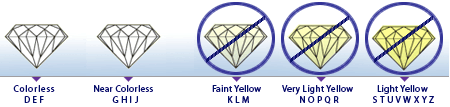
The Diamond Color Scale
D through F – Colorless
G through J – Nearly colorless; requires a loupe to determine color when unmounted
K through M – Possesses a faint yellow tint, usually requires a loupe to detect
N through R – Possesses a slight yellow tint which can be detected with the naked eye
S through Z – Obviously tinted yellow even when mounted
Color and Price
As one would expect, the closer a diamond gets to color grade D, the more expensive that particular gem is going to be. The jump in price per carat per color grade can easily be a thousand dollars. This means that a diamond can get expensive in a hurry.
Match Your Setting with Your Color Grade
Perhaps the most important factor in determining what color grade is the best for a particular shopper is what type of metal on which the diamond is going to be mounted on in a diamond ring, earrings, or other pieces of jewelry. Yellow gold can seem to amplify a lower grade diamond’s yellow tint. Platinum or white gold can help by removing that yellow frame of reference. This means that, unlike carat weight or clarity, the buyer has a little wiggle room when deciding on diamond color. However, for most buyers, a diamond in the range of J or K is usually fine especially when setting on a whiter setting. For yellower settings, a H or an I can be considered ideal.
Determining Factors
Obviously every diamond is unique. So, when you’re shopping for diamonds, color has to be weighed as a determining factor, and not necessarily a deciding one. Color must be considered along with the rest of the Four C’s to create a list of requirements for the perfect diamond based on the needs of you the shopper.
We know that most people do not make a habit of shopping for a diamond, so feel free to contact your diamond specialist here at Danforth.
The Best View Possible – 3D Diamond Rings January 10, 2008
Posted by Jill Renee in : Buying Diamonds, Buying Jewelry, Diamond Jewelry, Diamonds, Engagement Rings, Palladium Jewelry , add a commentPurchasing a diamond engagement ring is never an easy prospect, and when you add the thought of buying that ring online, there’s an entire level of uncertainty added. One is forced to take certain things into consideration when buying an engagement ring online – Is the picture online accurate? What does the other side of the band look like? Is the metal really that shiny? Fortunately, here at Danforth Diamond, we’ve taken some of the stress out of purchasing diamond engagement rings online.
At Danforth we understand that you might not know what a cathedral style ring or channel set diamonds looks like, and if the picture on the website doesn’t give you a great view, it’s understandable why you would be apprehensive about buying the ring. That’s why we’ve added a series of 3D pictures to the Danforth Diamond website. Our 3D views are the ACTUAL ring not a computer-generated photo of the ring in 3D.
Currently featuring over 20 rings, our 3D Diamond Engagement Rings give you the best possible view of the ring your interested in. Speed up, slow down, or completely stop the rotating image to see every angle of the diamond engagement ring you’re interested in to make sure that it’s exactly what she’ll want. You wouldn’t buy a car without at least seeing what the interior looks like, so why would you buy a diamond ring without seeing what the other side looks like? Take a look at our 3D Diamond Engagement Rings and you’ll quickly understand why we’re doing everything we can at Danforth Diamond to ease the ring buying process.
-Jill Renee
